February 2
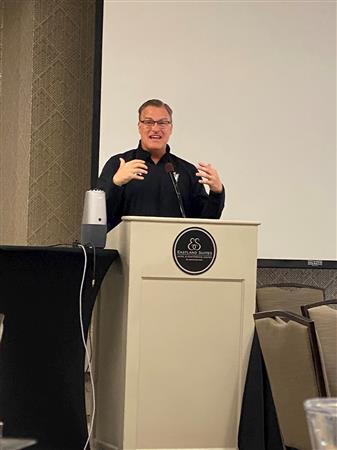
- Speaker: Bill Yoder - McLean County
States Attorney, Drug Court - Break
the Cycle
States Attorney Bill Yoder gave us
some background on the McLean County
Drug Court, a program designed for
hard core drug and alcohol non-violent
offenders that have hit "rock bottom"
and want to change. The program provides
treatment, education, job skills,
family skills, adversity training
and holds participant responsible.
Felony cases are screened by the States
Attorney's first, then the drug counselor's
office, and finally must be voluntary
by the participant for one to be considered
for "Drug Court." So far the
record is fantastic. There are 18
graduates of the Drug Court.
Prior to Drug Court their 18 people
accounted for 157 criminal cases.
Since graduating there have been zero
offenses other than speeding or seatbelt
violations. Jody Cooper, Drug Court
Coordinator, told us of the day to
day schedule for the 24 month program
that leaves very little free time
and requires frequent and random test
for sobriety. The program requires
sponsors, treatment, employment, or
community service, regular probation
checks, cell phone and unscheduled
visits by Jody. Then Scotty Lewis
spoke to us from a graduates perspective
regarding the Drug Court. He was introduced
to drugs and alcohol at a very early
age as his family used drugs in their
home as if it were an okay thing.
For years from age 6 up, he lived
in a mansion with parents and family
using drugs, and supported his self
esteem with drugs. He found the solution
to nearly everything via drugs and
alcohol. Then he stepped over the
"dotted line." He went to prison
six times. He said he had lost or
given away all the people in his life,
including his wife and children. He
had spent 16 years in prison, and
when released was no different than
when he went in. He was the caught
steeling a car and faced up 42 years
(due to prior convictions). He turned
himself into the treatment center
and went to the courthouse to talk
with Jody. He had heard about the
"Drug Court" while at the treatment
center. Scotty said, "The Drug Court
was an absolute miracle. It saved
my life. It introduced me to the recovery
process, added structure in my life,
and held me responsible." He now has
had three years of "good life." It
has made him whole with self esteem.
He now has a job, and he has rejoined
his wife and kids at home. It is his
biggest blessing. He attends church
regularly and continues the process
of rehabilitation, with support and
faith. In Kiwanis we help the world
one child at a time. Drug Court is
helping the world, one MAN at a time.
Speaker January
25 Meeting - Lawrence Hayes - Airline
Industry and Trends
Larry started in the September 1973
with TWA in St Louis. He was hired
as the mail clerk at Lambert Field.
Besides the airport, he has worked
in general reservations, the tour
department and the international rate
desk. He transferred to sales in 1978
and currently works for AA since it
was acquired by TWA. Larry filled
us in on the 2009 American Eagle Results
Good News
The industry is ahead of the GDP
Airline Travel has improved
New streams of revenues have appeared
like luggage charges and drink charges
Bad News
Travel is still way down
The price of fuel is now 40% of
their current expense report-more
than salaries
US unemployment is up to 10%
International demand is way down
Poor credit has forced prepayments
New to AA in 2010
31 new 737 aircrafts
Opened the new admirals club
Cabin upgrades
GOGO Internet flight Service
In 2009 AA lost $1.5 billion. The
good news is that its a billion better
then 2008. The company always carries
$5 billion in cash reserves.
January 18
Meeting - Speaker Linda Bowman, Camp
Limberlost Kids
With
the experience of more and more Limberlost
campers arriving with special needs,
Linda was asked to speak briefly about
the disabilities represented at camp,
what can be done to help these children,
and how being at camp could benefit
them. Many of the disabilities that
we see at our camp are quite invisible.
These include Mental Retardation/Intellectual
Impairment, Autistic Spectrum Disorders,
Attention Deficit and Hyperactivity
Disorders, Learning Disabilities,
and Speech and Language Impairments.
These children look like other children,
they do not act like it. So that,
Linda says, "Brings us to Camp Limberlost,
where children can get what they need,
and want, which is structure, direction
and organization." So if you think
that a camp full of kids is the wrong
place for child with social language
deficits, it is really the BEST place
for them to learn and practice the
linguistic forms and social skills
that lead to successful friendships.
Adult caring supervision, rules, model
behavior, cabin families, time away
from familiarity of family and home
provides opportunity and challenge
for the children.
History of
Kathryn Beich - Speaker Michael Holzworth
- January 11
There
was a candy salesman in Chicago by
the name of Paul F. Beich that had
a dream about making his own candy
to sell. So, in the late 1800's he
came to Bloomington's west side where
there was a caramel factory for sale.
The owner of the caramel factory was
in search of his idea that he could
produce milk chocolate. That's how
two candy factories began, Beich Candy
in Bloomington and one by the caramel
factory seller, Milton Hershey, who
started his new factory in Pennsylvania.
In the early 1900's the Beich Candy
Company made the famous Wizz Candy
Bar and the slogan, "Wizz the Best
Candy Bar There Is." Then Kathryn
Beich had this idea of selling candy
to churches as a fundraiser. While
most of the management thought this
to be a dumb idea, it became very
successful and soon all of the efforts
turned to "fundraising" marketing.
It became a four billion dollar industry,
selling 85 million bars and 8 million
tons of candy. As sales began to slow,
Beich decided it was time to sell
to the Nestle Company. Through the
90's, Nestle Beich help schools raise
nearly 80 million dollars. Kathryn
Beich continued until recently independent
of Nestle, and has now been sold to
Great American Opportunities in Nashville
Tenn.
Speaker January
4 - Marie Streenz - Wind Energy
Marie
Streenz is a local project manager
for the Twin Grove Wind Farm located
east of Bloomington along the Illinois
Route 9 highway. She received her
degree from Illinois State in Environmental
Health. Horizon Wind Energy develops,
owns, and operates wind farms throughout
the United States. Twin Grove is the
third largest and the largest east
of the Mississippi River. The Twin
Grove Farm is planning expansion in
the area north of Route 9 and has
received zoning board approval and
is awaiting county board approval.
In answers to questions we learned
that the goal is to produce 20% of
the electric need by 2025, and we
are now at about 8% of production.
Weather patterns are not expected
to be significant changes for the
midwest. The wind turbine begin to
turn with 3 mph of wind, produce at
9 mph and shut down at 44 to 50 mph.
They have received tax support in
the following ways: enterprise zones
where possible,stimulus package of
2 cents per kwh of production, and
tax credits. The return on investment
is based on a 10 year return. USA
manufacturers of turbines is increasing,
however General Electric is the largest
US producer, and has the most units
installed and is considered the "workhorse
of the industry." The locally
produced energy mostly goes north
toward Chicago, and the Pontiac area
uses the energy from the grid first.
We learned that the placement of grids
has many requirements, some technical
for production reasons, and others
due to roads, houses, natural habitats
and more. The benefits include a tax
base ($10,000 per wind turbine), jobs
during construction, and residual
maintenance jobs, and the power source
is free. The cost is maintenance,
lease cost and taxes. The growth rate
for wind energy is expected to be
23% annually.